“AI ruined my favorite hobby — I can’t afford a PS5 anymore.”
Example conversation from social listening
I led UX research for Microsoft Xbox to understand why gamers accept AI in some contexts and resist it in others. Through Brandwatch listening across Reddit, X, and Instagram, I compared in-game and platform AI and iterated the brief with Sr. Research Managers Josh Rivers and Melissa MacGregor.
Project status: Presented
Question
Why do gamer reactions to AI split so sharply depending on where it appears?
Approach
Started broad, then compared in-game and platform AI after stakeholder feedback.
Insight
Gamers don’t react to AI itself — they react to what AI threatens.
Outcome
Presented to Josh Rivers and Melissa MacGregor. Brief refined to in-game vs platform AI, with recommendations for optionality, transparency, and human fallback.
Role
Lead UX Researcher
Timeline
4 months · Jan–April 2026
Team
7-person interdisciplinary research team spanning UX · product · technical research · data · and strategy
Client
2 Senior Research Managers, Microsoft Xbox
01 · Question
Gamers seemed divided on AI. I wanted to understand why.
Some AI uses produced sharp backlash. Others were tolerated, or even treated as useful. That inconsistency was the problem.
How do gamer reactions differ when AI appears inside the game versus at the platform level?
In-game AI
Art
Assets
Storytelling
Mechanics
Performance
Platform AI
Moderation
Discovery
Accessibility
Recommendations
Other system experiences
Competitive landscape
Xbox
PlayStation
Nintendo
02 · Approach
Start broad
Xbox, PlayStation, and Nintendo — the competitive frame for the landscape scan.
01
Landscape
Xbox Wire
Gaming news
Competitive activity
Industry conversations
02Evidence
02
Social listening
Brandwatch
Reddit
X
Instagram
Read the conversations
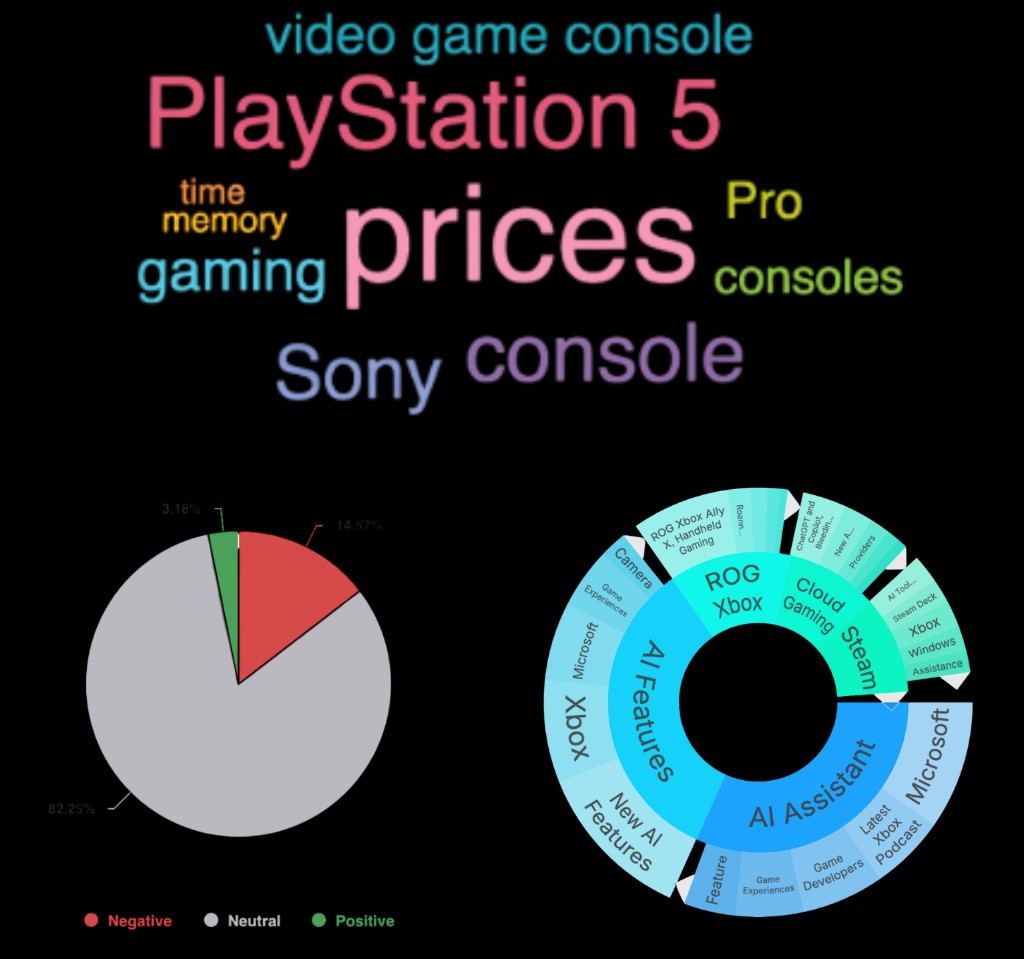
Brandwatch signals — topic volume, sentiment, and conversation clusters used to find threads worth reading.
03
Quantitative signals
Conversation volume
Sentiment
Emotion
Trending topics
Spike dates
04Evidence
04
Qualitative analysis
Individual conversations
Recurring themes
Emotional reactions
Cross-context comparison
Widen the brief
05Evidence
05
Stakeholder iteration
Josh Rivers
Melissa MacGregor
Senior Research Managers
Feedback expanded the research toward platform-level AI
Initial focus
AI-generated content
Creativity
Labor
Authenticity
→
Stakeholder feedback
“What happens when AI isn’t generating the game itself?”
→
Expanded research
Platform AI
Moderation
Recommendations
Performance
Pricing
Control
Brandwatch quantitative signals identified conversations worth investigating. They were doors, not a census of gamer opinion.
Signal
Conversation spikes and trending topics in Brandwatch
What I investigated
Which moments were worth opening, and on which platforms
What it helped me understand
Where tension clustered — not how all gamers feel
Signal
Sentiment and emotion movement
What I investigated
Individual posts behind the spike
What it helped me understand
Whether the heat was about the technology, or about a perceived loss
Signal
Platform differences across Reddit, X, and Instagram
What I investigated
The same theme in different rooms
What it helped me understand
A pattern that could travel — not a single-platform complaint
03 · Findings
Gamers don’t react to AI itself. They react to what AI threatens.
Creative AI
ThreatCreativity + human labor
ReactionEmotional backlash
Performance AI
ThreatDeveloper effort + quality
ReactionSkepticism
Platform AI
ThreatControl + fairness
ReactionDistrust
AI + Infrastructure
ThreatAffordability + access
ReactionFrustration
Finding 01
Creative AI threatens human creativity.
ReactionEmotional backlash
What I saw
When AI touched art, assets, or story, players reached for “AI slop,” replacement of artists, quality, and lack of disclosure. Crimson Desert is a useful example, not a measured sample.
What it meant
The complaint was about craft, labor, and authorship — not AI as a category.
Working insight
When AI appears to replace creative work, players perceive a loss of human authorship.
Finding 02
Performance AI changed the threat.
ReactionSkepticism
What I saw
DLSS and similar tools were discussed as a possible shortcut around optimization — cooler than outrage, still resistant.
What it meant
The imagined loss was developer effort and product quality, not authorship.
Working insight
The same technology produced a different reaction because players perceived a different loss.
Creative AI
AI → replaces creator → outrage
Performance AI
AI → reduces effort → skepticism
Finding 03
Platform AI moved the problem from creativity to control.
ReactionDistrust
What I saw
Moderation and recommendation talk described invisible decisions, little explanation, missing human review, and no usable appeal — including examples on YouTube and X.
What it meant
The emotion was not “AI slop.” It was whether anyone could explain or challenge the outcome.
Working insight
The problem wasn’t automation alone. It was unaccountable automation.
Invisible AI decision→
No explanation→
No human review→
No appeal→
Distrust
Finding 04
A secondary signal: AI became associated with access.
ReactionFrustration
What I saw
Some conversations linked AI industry demand to hardware cost and the feeling that staying in gaming was getting harder.
What it meant
Players treated AI as part of why access felt narrower. This work does not establish that AI caused a price change.
Working insight
Perception, not causal evidence.
Example conversation
“AI ruined my favorite hobby — I can’t afford a PS5 anymore.”
Example conversation from social listeningInterpretationPerception, not causal evidence.
04 · Synthesis
AI isn’t the variable. Perceived threat is.
What AI touches, what players perceive, and the reaction